Monday, July 5, 2010

Take Me to the River. Finally. By NATHAN WARD - New York Times, July 2, 2010

Take Me to the River. Finally.
By NATHAN WARD

New York Times - July 2, 2010


THIS summer, with the debut of the Brooklyn Bridge Park, as well as the expansion of Manhattan’s Hudson River Park and Governors Island, New Yorkers have celebrated the reclamation of the waterfront. But the effort, laudable though it is, obscures a not-so-insignificant historical misunderstanding: we are in fact claiming the waterfront, not reclaiming it.

From New York’s early days as a port to its receding days as a manufacturing town, the waterfront was never a place most people wanted to be. It was always a rough, strange world separate from the city it surrounds.

In the Colonial era, the waterfront was the province of those who wanted to go to sea, or at least to unload ships. Cargo-laden clipper ships entering the harbor produced a call for “Men Along the Shore!” — longshoremen. Back then, those men with the patience to keep alert for the flare or flag of an approaching vessel and the physical strength to “bull” cargo were really the only people allowed near the docks.

During the 19th century and early 20th century, the docks were a place of dangerous work done by often desperate men, many of them immigrants. In the 1915 study “The Longshoremen,” the sociologist Charles Barnes described an occupation that “involves such constant risk that a man becomes ‘work hardened’ or indifferent to the dangers around him.” Barnes authenticated 309 longshore accidents on the Manhattan waterfront, 96 of them fatal, in a single year.

By the middle of the 20th century, New York Harbor was the greatest port in the world, with more than 900 working piers. But as commerce boomed, so too did crime. The small-time heists by pre-Prohibition gangs gave way to territorial murders and organized pilferage. (Pier 45 at West Street, now a pastoral portion of the Hudson River Park, was so gang-ridden it couldn’t be rented out.)

Malcolm “Mike” Johnson, whose investigations for the old New York Sun won a Pulitzer Prize in 1949, called the city’s docks at the time a “waterfront jungle.” Murders, he wrote, are “commonplace, a logical product of widespread gangsterism.” Stealing was so rampant it amounted to an unofficial — and hefty — tax. One steamship company, the Grace Line, lost nearly $3 million in 1948 alone, 80 percent of it from its New York piers. The bolder pier heists of the era included an entire truck-sized electrical generator and a 10-ton shipment of steel.

The authorities were hampered by a waterfront “code” against squealing that was no Hollywood invention. “A man could be killed in broad daylight before half a dozen witnesses and nobody would testify about it,” wrote William Keating, a New York assistant district attorney. “On the waterfront, to talk was to rat, and to rat was to stand exposed and unprotected.” Dozens and dozens of murders went unsolved.

Not surprisingly, in 1931, when The New Yorker sent Alva Johnston to Irishtown — now the loft country of Dumbo — to investigate the deaths of 21 Brooklyn stevedores, he discovered that there had been no arrests, “not because there is anything secret or underhand about these murders, but because the witnesses won’t talk.” When detectives asked the wounded Red Donnelly, the Brooklyn dock boss, what enemy had balehooked and shot him in a waterfront shanty on Bridge Street, he coughed out, “John Doe” — and died pure.
Read the rest of this article here:

Sunday, June 27, 2010

I’m From Brooklyn, She Said in Her Southern Drawl - NY Times 6/27/10


I’m From Brooklyn, She Said in Her Southern Drawl
By Dvora Meyers

As a 27-year-old single woman living in Brooklyn, I enjoy the communal events that warm weather brings: summer concerts in Prospect Park, street fairs, outdoor dining with friends. But with the social spirit comes an uptick in street-side proselytizing by evangelists for Brooklyn, who insist that theirs is the one true borough. They are even more grating than the subway preachers who roam the cars on Sundays. I’d much rather listen to a sermon than an ode to a utopia that doesn’t remotely resemble the place where I grew up.

I spent most of my girlhood in Canarsie, where the L train goes after all the hipsters and artists debark. I took two city buses to my school in Midwood, passing Flatlands Avenue and the Arch Diner, the local mob hangout. I saw no cheese or coffee shops, which is why I don’t live in Canarsie anymore.

I left for hipper pastures, like Los Angeles and the Upper West Side, but I eventually returned — not to the Brooklyn of my childhood, but to “Fakelyn,” a k a Clinton Hill, where I moved last August. The neighborhood had everything I wanted: reasonable rent, good subway coverage and a nearby Target. I’m also keen on all the stores with monosyllabic titles, like Cloth and Bliss. And I love that the only Brooklyn accent I regularly hear is my mother’s on the phone.

My neighbors, most of whom aren’t from around here, can’t admit that their New York experience isn’t authentically gritty. Worse still, most have developed amnesia and have forgotten their pre-Brooklyn existence. When I lived in Los Angeles, I never claimed to be an Angeleno, but when I ask a Brooklyn resident where she hails from, she immediately answers, “Brooklyn.” In a strong Southern drawl.
Read the rest of this article here:

Tuesday, June 15, 2010

1907 Brooklyn Bridge Night View Postcard


1907 Brooklyn Bridge Night View Postcard

Saturday, June 5, 2010

Clinton Irving Jones - Period Brooklyn Photographs

This collection of Clinton Irving Jones photographs was exhibited at the Underbridge Gallery curated by David Sokosh. These period photographs taken by Clinton Irving Jones between 1905 - 1911, capture the fading vestigial remnants of Brooklyn's old Dutch architecture and provide a glimpse of Brooklyn when farmhouses and barns were part of the Brooklyn landscape.

Photos Courtesy Underbridge Pictures

For more information about this collection, please read the New York Times article here: http://www.nytimes.com/2006/10/29/nyregion/thecity/29farm.html?ex=1319778000&en=c0211f73e1ced434&ei=5088&partner=rssnyt&emc=rss


Clinton Irving Jones - Snerderken House


Clinton Irving Jones - Gerritsen's Tide Mill House


Clinton Irving Jones - Old House at 1224 Fulton Street


Clinton Irving Jones - Schenck-Crooke House


Clinton Irving Jones - Schenck-Crooke House Interior


Clinton Irving Jones - Houses on Franklin Avenue


Photos Courtesy Underbridge Pictures

Wednesday, December 9, 2009

David Sokosh Tintypes Exhibition


Victory's Trumpet, Brooklyn

16 x 16 Inches (Image Size), Silver Print on Paper, Edition of 10


Brooklyn-based photographer David Sokosh is exhibiting some of his remarkable tintype black & white images at MDH Fine Arts located at 233 West 19th Street, New York, NY 10011. GALLERY HOURS: Tuesday - Friday 12-7, Saturday 12-6, Closed Sunday & Monday. ANGELS - A group show featuring works by Miranda Girard, Robert Goldstrom, Michael Henry, John Neely, Charles Ramsburg, Alfred Schatz, Jimmy Shack, David Sokosh and Tatiana Zayka. Show begins on Tuesday, December 8th and will run through Thursday, December 31st.

Friday, November 13, 2009

Brooklyn Historical Society Photography Collection


John D. Morrell Photograph Collection
Photographer Morrell, John D., 1921-1988
Date 05/18/1959
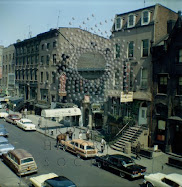
Description North side of Montague Street between Clinton + Henry Streets looking northwest. Taken from window of #156 Montague Street.

The Brooklyn Historical Society Photography Collection has placed hundreds of Brooklyn streetscapes photographs from its extensive Brooklyn photography archives online. From this broad assortment of period photos the viewer can get a glimpse of Brooklyn's architectural assortment from several decades of photographic imagery.

Sunday, May 31, 2009

East River Scene by Elisha Taylor Baker


"Sunrise from Chapman Dock and Old Brooklyn Navy Yard, East River, N.Y."
by Elisha Taylor Baker, 1886 - Oil on canvas.